GStack: Turn Claude Code Into a Full Engineering Team

GStack: Turn Claude Code Into a Full Engineering Team
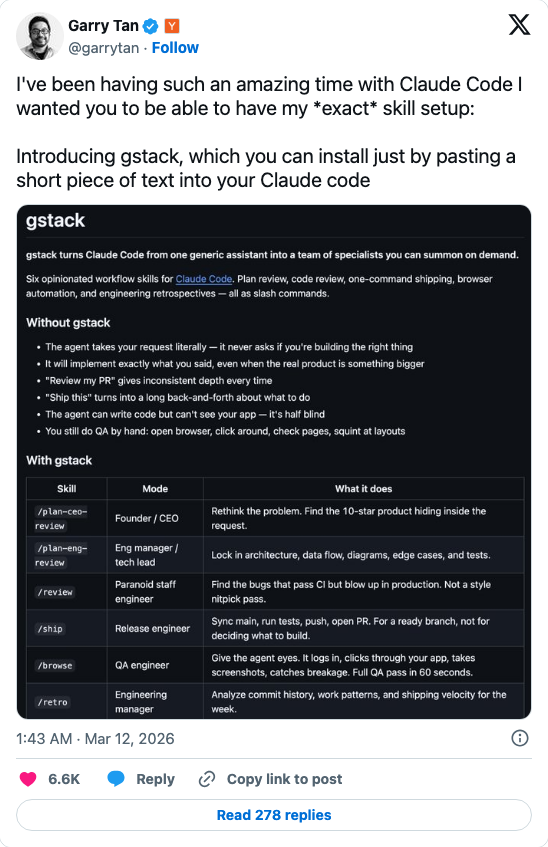
The first time you type /office-hours into Claude Code with GStack installed, something strange happens. The AI stops acting like a helpful coding assistant and starts acting like a skeptical product manager who thinks your feature idea is probably wrong.
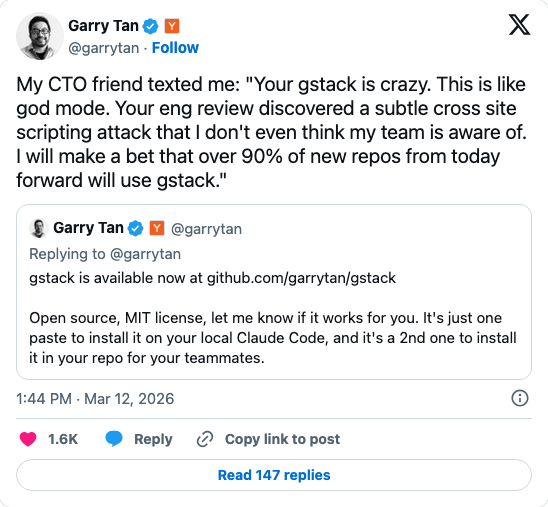
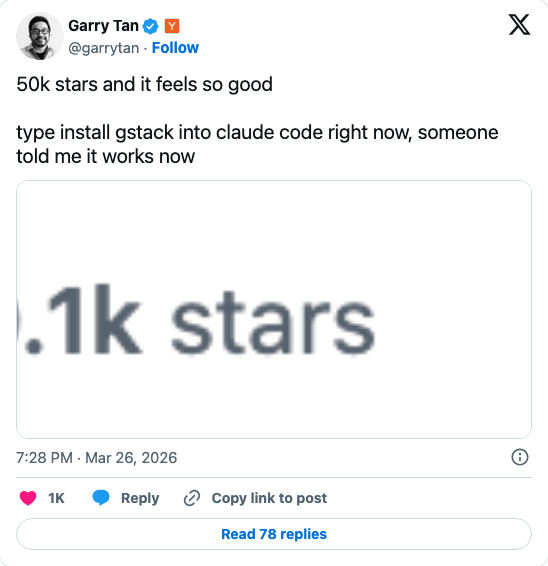
That is the design. And it is why GStack — Garry Tan's open-source Claude Code skill setup — has accumulated 82,700 stars and 12,000 forks on GitHub since its March 2026 launch.
For context: Garry Tan is the President and CEO of Y Combinator. When the person who has reviewed more startups than almost anyone else on earth open-sources the exact AI development workflow that runs his code, developers pay attention. They also argue about it extensively on Hacker News.
This guide explains what GStack actually does, how it compares to oh-my-openagent and other harnesses, why the "it's just prompts" criticism misses the point, and whether it belongs in your workflow.
What GStack Actually Does: The 23 Skills
GStack is not a new coding assistant. It is a collection of CLAUDE.md skills — structured instructions that give Claude Code specialist personas. Install it in your project, and Claude Code gains access to 23 tools that simulate an engineering team.
The roles divide into recognizable job functions:
Planning and Strategy
/office-hours— Product interrogation with forcing questions. Challenges your idea before you build it./plan-ceo-review— Strategic scope challenge. Asks whether you are solving the right problem./plan-eng-review— Architecture and testing challenge. Finds the assumptions in your technical plan./plan-design-review— Design system audit. Catches "AI slop."/plan-devex-review— Developer experience review of the plan./autoplan— Runs CEO, Engineering, and DevEx review in sequence automatically.
Design and Implementation
/design-consultation,/design-shotgun,/design-html/review— Code review targeting security issues, bugs, and architectural concerns./investigate— Root-cause debugging with structured reasoning.
Testing and Quality
/qa— Live browser testing with fixes applied inline./qa-only— Bug reporting without code modification./cso— Security audit applying OWASP Top 10 and STRIDE threat modeling.
Release and Deployment
/ship,/land-and-deploy,/document-release
Additional Tools
/browse,/canary,/benchmark,/retro,/codex,/pair-agent,/learn
The Conductor: Parallelizing Everything
The Conductor coordinates multiple Claude Code sessions simultaneously in isolated workspaces — one on a new idea, one reviewing a PR, one implementing, one on QA. Each gets its own git worktree and context window.
This is what makes GStack genuinely novel: multi-agent orchestration built into the harness, not a separate tool.
The Productivity Claim: 810×
Garry Tan reports 810× productivity improvement over his 2013 baseline — 11,417 logical lines/day vs 14. The metric uses "logical LOC" (meaningful changes, not raw lines), and the baseline is his own pre-AI experience. Not a controlled experiment, but an honest personal data point.
The TechCrunch analysis notes developers in hardware-adjacent or regulated domains see much smaller gains.
The "Just Prompts" Criticism
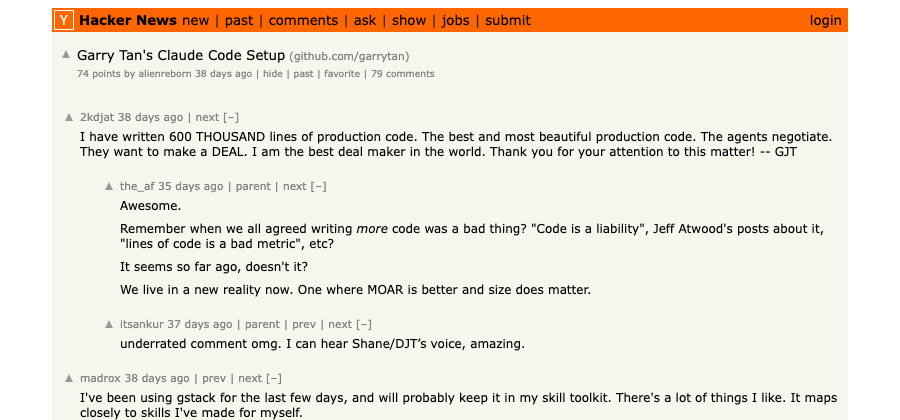
The most common dismissal: GStack is "a bunch of prompts in a text file." Partially correct, mostly misses the point.
The value is in the system design — separating planning from implementation, adversarial reviewing roles, security audits as a default step before shipping. Software engineering principles applied to AI agent orchestration.
GStack vs the Field
| GStack | oh-my-openagent | GSD | cc-switch | |
| Stars | 82.7K | 53.9K | 35K | 54K |
| Model lock-in | Claude Code only | Multi-model | Claude Code first | Model-agnostic |
| Specialist roles | 23 skills | 11 agents | Spec-driven | None |
| Parallel sessions | Yes (Conductor) | Yes | No | No |
| Install | 30 seconds (paste) | npm install | Manual | CLI |
oh-my-openagent routes tasks to the best model for each job. GStack is entirely Claude Code native. Different problems.
When GStack Wins, When It Doesn't
Use GStack when: you are a Claude Code user building a SaaS or web product, working solo or on a small team without dedicated QA/security review.
Skip GStack when: you need multi-model routing (use OmO), your team already has strong review culture, or you are on OpenCode/non-Claude agents.
Getting Started in 30 Seconds
Open Claude Code and type: Install GStack. Done.
First commands to run:
/office-hours— Challenge your current feature idea/cso— Security audit on your last commit/autoplan— Full CEO + Eng + DevEx review of your next plan
The Bottom Line
GStack makes software engineering best practices the default, not the exception. The frontier in AI-assisted development is not a better autocomplete — it is a well-designed team of reviewers who catch the mistakes you were going to make anyway.
Originally published at AgentConn


